Updated: Feb 22

Understanding Order Flow Segmentation and Risk Monitoring in Modern Brokerage Models
How Brokers Detect Toxic Traders is a topic rarely discussed openly. The term “toxic” does not refer to unethical behavior. In brokerage terminology, toxic flow typically describes order flow that creates asymmetric risk for liquidity providers or brokers.
Understanding how brokers classify order flow reveals how routing decisions are made, how execution may change, and why certain accounts experience structural differences over time.
This is not about accusation. It is about mechanics.
What Is “Toxic Flow”?
In brokerage risk management language, toxic flow refers to trading behavior that statistically disadvantages liquidity providers.
Examples may include:
• Latency arbitrage • News-based microsecond execution • Quote stuffing exploitation • Systematic slippage exploitation • High-frequency scalping targeting pricing delays
Toxic does not mean illegal. It means statistically difficult to hedge profitably.
Liquidity providers aim to manage risk exposure, not to reward adverse selection.
Why Brokers Monitor Order Flow
Brokers operate under defined risk models.
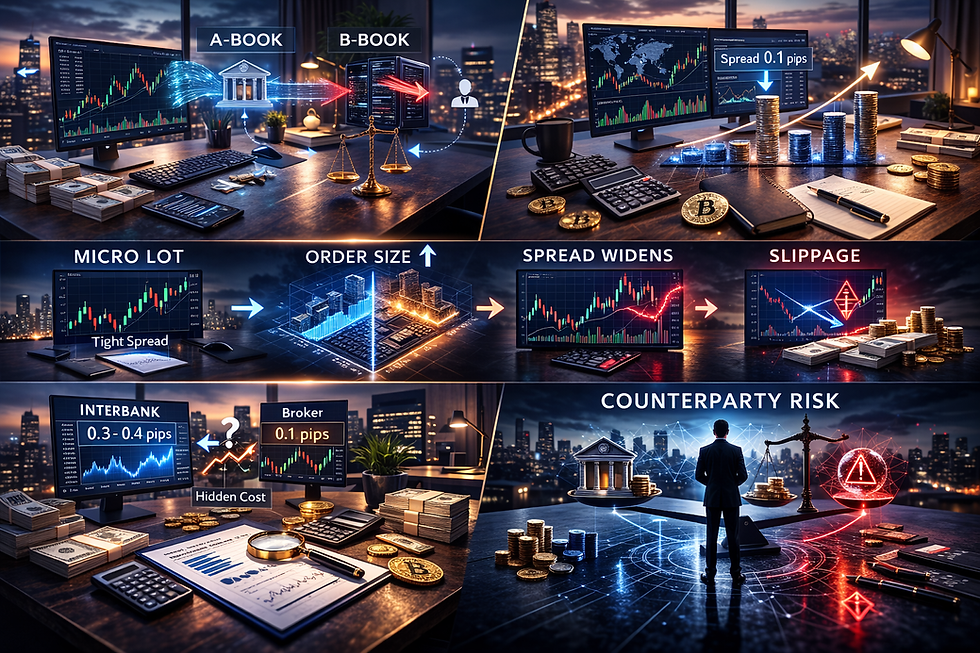
Whether using A-Book, B-Book, or hybrid routing, they must control exposure.
Monitoring includes:
• Win-rate consistency • Profit distribution • Trade duration • Time-of-day concentration • Order execution speed • Fill-to-cancel ratios
This monitoring supports risk containment.
It is a structural necessity.
Latency Arbitrage Detection
Latency arbitrage occurs when traders exploit pricing delays between venues.
If a broker’s quote lags the broader market by milliseconds, an algorithm may repeatedly capture that inefficiency.
Brokers measure:
• Execution time delta • Fill advantage frequency • Slippage asymmetry • Correlation to external price feeds
Repeated latency exploitation can trigger routing changes.
This is not retaliation. It is exposure management.
News Trading Behavior
High-impact economic releases create temporary liquidity vacuums.
Spreads widen. Depth thins. Volatility spikes.
If a trader consistently enters milliseconds before spread expansion and exits immediately after volatility stabilizes, this behavior is statistically identifiable.
Brokers track:
• Trade timing relative to scheduled releases • Profit clustering during news windows • Slippage distribution patterns
Repeated patterns may classify the account as adverse flow.
Hybrid Routing and Flow Segmentation
Most brokers operate hybrid models.
Not all accounts are treated identically.
Routing may depend on:
• Profitability history • Risk score • Holding time • Volatility interaction • Net exposure impact
Profitable and statistically adverse accounts may be routed externally to liquidity providers.
Statistically losing accounts may remain internalized.
Segmentation stabilizes broker revenue variance.
The Risk Score Model
Some brokers utilize internal risk scoring algorithms.
These systems may analyze:
• Rolling profitability • Trade expectancy • Position sizing volatility • Correlation to broader market movement • Abnormal fill advantage
The output does not determine morality.
It determines exposure strategy.
Accounts may be flagged for routing adjustment rather than restriction.
Execution Changes Traders May Notice
When routing changes, traders might observe:
• Slight spread variation • Increased slippage during volatility • Reduced fill priority • Execution routing shifts
These changes often reflect routing model adjustments rather than punitive intent.
Structural transparency varies across firms.
Understanding segmentation clarifies behavior.
Why Toxic Flow Is a Business Concern
Liquidity providers price risk into spreads.
If certain traders consistently exploit micro-inefficiencies, providers increase spread or reduce exposure.
Broker margins compress under adverse flow concentration.
Risk must be offset.
Segmentation is a risk equalization tool.
This is economic logic, not ethical judgment.
Is Being “Toxic” Good?
From a trader’s perspective, being consistently profitable through structural inefficiency detection may indicate skill.
From a broker’s perspective, it may indicate unhedgeable exposure.
These two perspectives are not symmetrical.
Professional institutional traders often operate in environments designed to accommodate sophisticated flow.
Retail brokerage infrastructure is not always optimized for high-frequency adverse selection.
Environment matters.
Structural Transparency and Execution Environment
Serious traders evaluate:
• Whether routing is disclosed • Whether execution model is transparent • Whether slippage distribution remains statistically balanced • Whether withdrawal policy remains stable under profitability
Understanding broker-side detection does not imply wrongdoing.
It clarifies structural alignment.
The Professional Reality
Institutional trading environments assume sophisticated flow.
Retail environments often assume statistical loss distribution.
If a trader becomes consistently profitable, routing adjustments may follow.
This is predictable.
The key question becomes:
Is the trading environment structurally aligned with long-term profitability?
Execution infrastructure determines sustainability.
Internal Links
A-Book vs B-Book Explained Raw Spread vs Tight Spread Why 95% of Traders Lose The Hidden Cost of Leverage in FX Trading Best Prop Firms How to Get Funded Without a Challenge Free Trading Journal
FAQ
What is a toxic trader?
A toxic trader is typically defined as one whose order flow creates consistent adverse selection risk for liquidity providers.
Is toxic trading illegal?
No. It refers to flow characteristics, not legal violations.
Why would brokers change routing?
Routing changes help manage exposure when certain accounts become statistically difficult to hedge.
Does routing adjustment mean unfair treatment?
Not necessarily. It reflects internal risk management models.
How can traders avoid routing issues?
By understanding execution structure, avoiding exploitative latency behavior in retail environments, and choosing infrastructure aligned with strategy.
Do institutional environments treat toxic flow differently?
Institutional venues are generally structured to handle sophisticated and high-frequency flow.